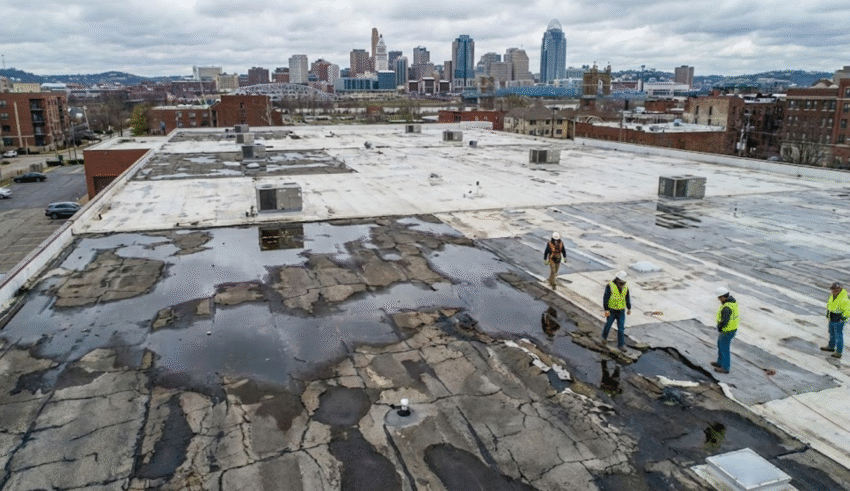
For facility managers and business owners in Cincinnati, the roof is the first line of defense against the unpredictable Ohio Valley weather. However, because it is out of sight, it is often out of mind, until a ceiling tile stains or water drips onto expensive machinery. Reactive maintenance is the most costly way to manage a building. The key to protecting your investment and budget is recognizing the early warning signs that indicate professional intervention is needed.
Catching these issues early can mean the difference between a simple repair and a catastrophic, expensive replacement. Here are the top signs that you need to call a commercial roofing expert immediately.
1. Visible Water Damage Indoors
The most obvious sign is water intrusion, but it often manifests subtly before it becomes a flood.
- Stained Ceiling Tiles: Brown or yellow rings on ceiling tiles are a clear indicator of a slow leak.
- Peeling Paint: Moisture trapped in the walls can cause paint to bubble or peel near the ceiling line.
- Mold or Mildew: A musty smell in the upper floors often signals hidden moisture proliferation.
If you see these signs, the water has already breached the roof system and the insulation. Immediate action is required to prevent structural rot.
2. Blistering or Bubbling Membrane
On flat commercial roofs (common in Cincinnati warehouses and retail centers), the membrane should be flat and tight. If you walk the roof and see bubbles or “blisters,” it means moisture or air has trapped trapped between the membrane and the insulation.
As the sun heats the roof, this trapped pocket expands, stretching the membrane until it cracks or tears. This is a sign of adhesion failure and requires professional repair to cut out the damaged section and re-seal the system.
3. Standing Water (Ponding)
Flat roofs are designed with a slight pitch to drain water. If you see “ponding water” (water that remains on the roof for more than 48 hours after a rainstorm), you have a drainage issue.
Standing water is heavy. It adds structural stress to the building and deteriorates the roofing material prematurely. It can be caused by clogged drains, compressed insulation, or poor original design. A contractor can install tapered insulation or additional drains to correct the flow.
4. Flashing Separation
Flashings are the metal strips installed around perimeter edges, HVAC units, vents, and skylights. They are the most vulnerable points on any roof. Due to the expansion and contraction caused by Cincinnati’s temperature swings, flashings can pull away from the curb or the wall.
If you see gaps in the flashing or loose sealant, water has a direct path into the building. Clients trust commercial roofing contractors Cincinnati for leak repairs, roof coatings, and complete installations backed by manufacturer warranties. A professional will re-secure and re-seal these critical junctions.
5. Increased Energy Costs
A failing roof often loses its thermal efficiency. If your heating bills in winter or cooling bills in summer have spiked without a change in operations, wet insulation might be the culprit. Wet insulation acts like a conductor rather than an insulator, pulling heat out of your building. An infrared scan by a roofing contractor can identify these wet spots.
6. Loose or Missing Fasteners
On metal roofing systems, thousands of fasteners hold the panels in place. Over time, vibration from wind and thermal movement can cause these screws to “back out.” If you look up at a metal roof or walk upon it and see loose washers, missing screw heads, or panels that rattle in the wind, the roof is susceptible to “wind uplift.”
During a severe Cincinnati storm, loose panels can be ripped off entirely, exposing the building’s interior and causing massive damage to vehicles or people below. Tightening and replacing fasteners is a standard maintenance task that prevents disaster.
7. The Age of the Roof
Finally, simple age is a critical factor. Most commercial roofing systems have a designated lifespan, typically 20 to 25 years for TPO or EPDM, and perhaps longer for metal. If your roof is approaching this age, you should schedule a professional inspection even if there are no obvious leaks.
Materials degrade over time due to UV exposure. A proactive inspection can determine if the roof is a candidate for a “restoration coating” (which costs half as much as a replacement) or if it needs a full tear-off. You can check their local service reviews to see how they have helped other local businesses extend the life of aging roofs through timely intervention.
By staying vigilant and partnering with a trusted local expert, you can ensure your facility remains safe, dry, and efficient, avoiding the chaos of emergency shutdowns.
Frequently Asked Questions (FAQ)
Q: Can a commercial roof be repaired in the winter in Cincinnati?
A: Emergency repairs can be done year-round. However, full replacements or the application of coatings are difficult in winter due to temperature restrictions on adhesives and safety hazards from ice and snow.
Q: What is an infrared roof scan?
A: An infrared (thermal) scan is a non-invasive inspection method. A drone or handheld camera detects temperature differences on the roof surface. Wet insulation retains heat longer than dry insulation, showing up as a “hot spot” on the scan, allowing contractors to pinpoint leaks accurately.
Q: How often should I have my commercial roof inspected?
A: At a minimum, you should schedule inspections twice a year: once in the spring (to check for winter damage) and once in the fall (to prepare for winter).